


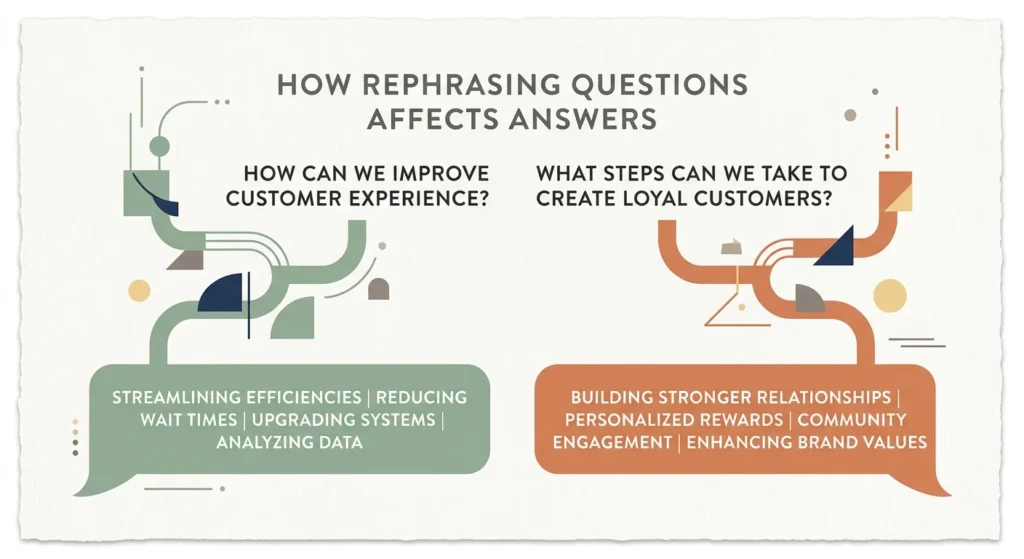
Ask an AI search tool something, don’t love the answer, rephrase it slightly, and hit enter again — and you can end up with a genuinely different response, not just a reworded version of the first one. That’s not a glitch. It’s a byproduct of how these systems actually work, and once you see the mechanics, it stops being confusing and starts being predictable.
This is a companion problem to what happens when two different AI search engines disagree with each other — but here, it’s the same tool, sometimes the same session, giving you two different answers just because you worded the question differently.
Different Wording Means a Different Question, as Far as the Machine Is Concerned
The most basic reason is also the least obvious one: two questions that mean the same thing to a person often don’t look the same to a retrieval system. A Microsoft engineer answering exactly this issue for Azure’s AI search product laid it out plainly — a longer, more specific phrasing of a question can pull back detailed information, while a shorter, more general version of the same question can retrieve broader or entirely different results, because the system re-ranks and reinterprets relevance based on the specific words used, not just the underlying meaning a human would assume is identical.
This is sometimes described as “semantic drift” — a small change in phrasing shifts which stored passages or web pages the system judges to be most relevant, even when you, the person asking, don’t feel like you changed the question at all.
The Way AI Writes Its Answer Has Randomness Built In
Even when the retrieved information stays the same, the answer you get can still vary — because language models don’t generate text by looking up a fixed response. They generate it one word at a time, choosing from a range of statistically likely next words rather than always picking the single most probable one. According to an explainer on this exact behavior, this sampling process means that even asking a model to be as consistent as possible doesn’t guarantee identical wording twice, since small internal fluctuations in how probabilities are calculated can nudge the response in a slightly different direction each time, as described by Evertune’s research team.
Rephrase the question on top of that built-in randomness, and you’re not just introducing one source of variation — you’re introducing two.
Rephrasing Changes What the AI Actually Goes and Looks Up
Modern AI search tools don’t just answer from memory — most run their own background searches to gather current information before writing a response, a process sometimes called “query fan-out.” The exact sub-searches a tool runs are shaped by how you phrased your original question, so a slightly different wording can send the system looking at a different set of web pages entirely, according to an analysis of how generative search engines diversify their sourcing, per SEO.com’s research. If the retrieved pages differ, the final answer built from them differs too — not because the AI is being inconsistent for no reason, but because it genuinely did different homework based on your wording.
This is part of why AI search doesn’t behave like traditional search, where the same query reliably returns the same ranked list of pages for everyone. AI search is closer to a fresh research process each time, assembled from whatever fragments of text the system’s specific sub-searches happened to surface.
A Technical Wrinkle Most People Never Hear About: Even Identical Questions Aren’t Always Processed Identically
Here’s the part that surprises even people who understand the basics above. Some AI companies have found that even the exact same question, asked the exact same way, can produce different answers due to how the underlying computer hardware processes requests — a phenomenon that has nothing to do with wording at all.
The explanation involves batching. When you send a question to an AI system, your request usually isn’t processed alone — it’s grouped together with other people’s requests so the hardware can handle them efficiently, and the size of that batch changes from moment to moment depending on how busy the service is. Some of the core mathematical operations inside these models aren’t what engineers call “batch invariant,” meaning the order numbers get added together can shift slightly depending on the batch size — and because floating-point math is sensitive to the order operations happen in, this can introduce tiny computational differences that occasionally cascade into a different word choice partway through the answer, according to a summary of this research. The same source notes that researchers have confirmed you can get bit-for-bit identical results running the same calculation on the same hardware in isolation — the variation only shows up once real-world server load and batching enter the picture.
In plain terms: sometimes it’s not your wording, and it’s not even randomness in the traditional sense. It’s server traffic.
Your Own Conversation History Is Quietly Shaping the Answer Too
If you’ve asked several other questions earlier in the same chat session, that context doesn’t just disappear once you move on to a new question — it continues to shape how the system interprets what you ask next. Earlier prompts shift the probability distribution the model draws from for everything that follows, according to an analysis of this effect from a marketing-focused AI research group, as detailed by Godmode Digital. Ask the same question in a fresh, empty chat versus a session where you’d just been discussing an entirely different topic, and you can get a noticeably different answer — even on the same account, using the same model, within the same minute.
This effect shows up even when personalization or memory features are switched off, since it’s a property of how the conversation itself is processed, not a stored profile being consulted.
Does This Mean You Can’t Trust AI Search Results?
Not exactly — but it does mean you should judge what’s actually changed, rather than assuming any difference in wording is a problem. A useful rule, drawn from the same research on AI inconsistency: separate wording from substance. If two answers say functionally the same thing in different sentences, nothing has actually gone wrong — you’ve just seen the normal variation described above. But if the substance itself differs on something checkable — a number, a date, a fact that can be verified — treat both versions as unconfirmed until you check a reliable source, rather than assuming whichever one you saw first, or whichever one sounds more detailed, is the accurate one.
This ties directly into the same trust gap covered in our breakdown of what to do when two separate AI search engines give conflicting answers — the underlying advice is the same whether the disagreement comes from two different tools or two different phrasings of your question to the same tool.
How to Get More Consistent Answers From AI Search
A few habits noticeably reduce this kind of drift, even though you can’t eliminate it entirely:
- Be specific rather than open-ended. Vague, broad questions leave more room for the system’s interpretation to shift between attempts. A precise question with clear scope tends to produce more stable answers across rewordings.
- Ask for sources, and check them. If a tool cites where its answer came from, you can verify whether a change in wording actually pulled from different material — which tells you whether a different answer reflects genuinely different information or just different phrasing of the same underlying facts.
- Start a fresh session for anything you’re testing for consistency. Since prior conversation context measurably shifts how a new question gets interpreted, comparing answers within the same long chat isn’t a clean test of whether your wording is what changed the result.
- For anything checkable and consequential — numbers, dates, current facts — verify against an independent source rather than treating a second AI answer, or a rephrased version of your first question, as confirmation.
- Don’t read short, incidental wording differences as a red flag. Some variation is simply how these systems work under the hood, down to server load and batching effects you have no visibility into or control over.
Frequently Asked Questions
Why does ChatGPT give me a different answer when I ask the same question differently
Rephrasing changes how the system interprets your intent, which can shift what information it retrieves and how it constructs the response. On top of that, language models generate answers through probabilistic word-by-word prediction, which introduces natural variation even without any change in wording at all.
Can I get the exact same answer every time by asking the same question the same way?
Not reliably. Even identical questions can produce different answers due to server-side batching effects that introduce tiny computational differences, on top of the inherent randomness in how these models generate text.
Does my previous conversation affect the answer to my next question?
Yes. Earlier prompts in the same session shape how a later question gets interpreted, even with personalization or memory features turned off, since this is a property of how the conversation itself is processed rather than a stored user profile.
Is it a problem if two AI answers to a rephrased question use different wording?
Not necessarily. The useful distinction is between wording and substance — if both answers convey the same underlying facts in different sentences, nothing has actually gone wrong. It’s worth investigating further only when the actual substance differs on something checkable.
Should I trust an AI search answer more if I get the same result after rephrasing my question?
Consistency across rewordings is a mild positive signal, but it isn’t proof of accuracy — a model can be consistently wrong. For anything with real consequences, verify against an independent, checkable source rather than relying on repeated AI answers alone.
Do AI search engines all handle rephrased questions the same way?
No. Tools vary in how aggressively they reinterpret rephrased questions, how they run background searches based on your wording, and how much conversation history they weigh — which is part of why the same rephrasing can produce more noticeable drift on one AI search tool than another.
