


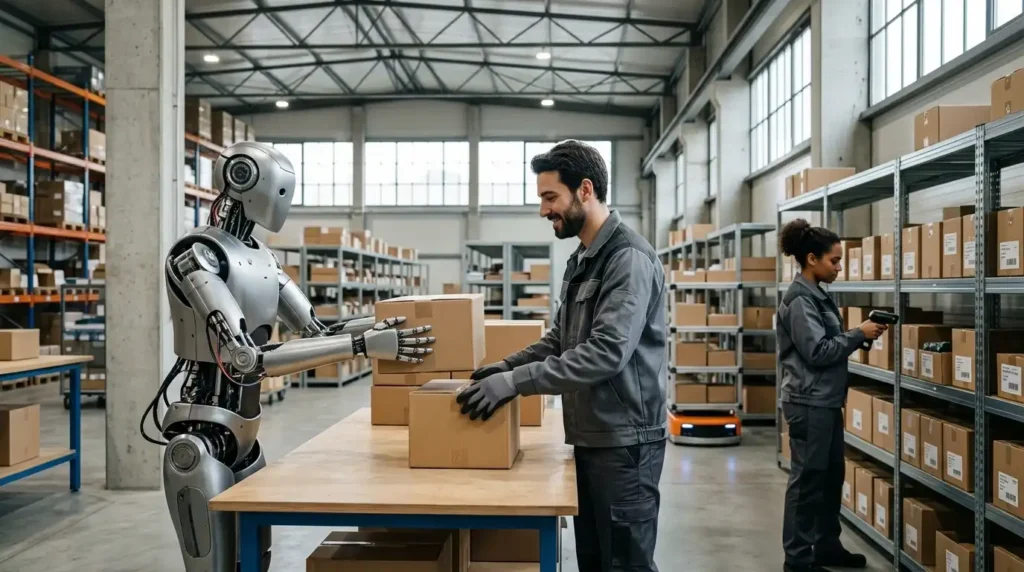
Humanoid robots have moved off the trade-show stage and onto real factory floors. Figure’s robots are logging paid hours inside BMW’s Spartanburg plant. Agility’s Digit has moved over 100,000 totes at a GXO warehouse. Unitree shipped more than 5,500 units in 2025 alone. None of that means a robot is coming for your job tomorrow — but it does mean the question “which jobs are actually at risk” now has real evidence behind it instead of just speculation.
This isn’t a “robots will take everyone’s jobs” article. It’s a look at which specific jobs involve the kind of work humanoid robots are already good at, which ones are further off, and why — with the evidence sorted by what’s happening now versus what companies are promising for later.
Will Humanoid Robots Really Replace Jobs?
The jobs most vulnerable to humanoid automation share a specific profile: repetitive physical work, in predictable environments, involving heavy lifting, simple object manipulation, or material movement. Warehouse picking, factory material handling, sorting, and basic packaging all fit that description. Jobs built around judgment calls, unpredictable surroundings, or complex human interaction don’t fit it, and that’s exactly why they show up much later in this list.
Humanoid robots are interesting for a specific reason that wheeled or fixed-arm robots aren’t: they’re built to work in spaces designed for humans. A warehouse already has aisles sized for people, shelves at human reach height, and carts with human-sized handles. A robot with legs and arms can, in principle, use that same infrastructure without a company ripping out its floor plan and rebuilding it around a machine. That’s the pitch, anyway — and it’s one of the real reasons companies are investing billions in humanoid form factors instead of just building more specialized robot arms.
The most important thing to understand before going further: task automation and job replacement are not the same thing. A warehouse worker doesn’t do one job all day — they carry boxes, sort inventory, fix mistakes, communicate with a supervisor, and handle whatever unexpected thing happens next. A robot might take over the box-carrying and basic sorting. The exception-handling and judgment calls tend to stay human, at least for now. Keep that distinction in mind as you read through the ten jobs below — in most cases, what’s changing is the job’s composition, not its existence.
Read Also: How Much Does a Humanoid Robot Cost in 2026?
1. Warehouse Workers
Warehousing is the single strongest real-world case for humanoid automation today, and it’s not close. Agility Robotics’ Digit has moved over 100,000 totes under a Robots-as-a-Service contract at a GXO fulfillment facility, completed an 11-month commercial pilot at a Toyota manufacturing facility, and is running in Amazon fulfillment centers alongside Amazon’s existing wheeled robot fleet. That’s not a demo — those are documented, paid deployments.
The tasks that translate well: picking items off shelves, packing totes, sorting inventory, moving material between stations, and loading and unloading. Because warehouses already have aisles, shelves, doors, and carts built to human dimensions, a humanoid robot can move through that space without a facility redesign — which is a big part of why this sector moved first.
What still needs a person: handling damaged or oddly shaped inventory the robot hasn’t been trained on, resolving order discrepancies, and the general troubleshooting that happens constantly on a real warehouse floor. Reliability numbers back this up — one widely cited 2026 industry analysis found the best documented factory-floor success rate hovering around 90% on a single task, well below the roughly 99% reliability expected on a standard production line. That gap is exactly why most warehouse deployments today are robots working alongside human teams, not replacing them outright.
2. Factory Assembly Workers
Automotive manufacturing is the second major proving ground, and it’s being pulled forward by carmakers specifically. Figure’s robots completed an 11-month deployment at BMW’s Spartanburg plant loading sheet-metal parts into car body assemblies, reportedly with greater than 99% placement accuracy across more than 1,250 operational hours. BMW is also piloting a robot called AEON, targeting full production on high-voltage battery assembly in Europe by the end of 2026. In China, UBTech’s Walker S robots are assisting with assembly tasks on BYD and NIO production lines, and the company has booked over 800 million yuan (roughly $112 million) in orders.
Tasks that fit: moving components between stations, basic part placement, machine tending, and repetitive fastening. Tasks that don’t: high-speed, high-precision work like welding and stamping, which still firmly belongs to traditional fixed-arm industrial robots that have decades of sub-millimeter repeatability behind them. Humanoids aren’t trying to replace that category of automation — they’re filling in the flexible, lower-precision gaps around it.
3. Packaging Workers
Repetitive packaging tasks — filling boxes, sorting products by type, placing items into containers, prepping shipments — are mechanically similar to warehouse picking, which is why they show up in the same pilots. The advantage here is consistency: a robot doing the same box-filling motion doesn’t get sloppier over an eight-hour shift the way fatigue can affect a human worker’s pace late in a shift.
The limiting factor is variability. Packaging lines that handle a narrow, predictable range of product shapes and sizes are realistic near-term automation candidates. Lines that handle constantly changing SKUs, fragile items, or irregular packaging still lean on human dexterity and judgment, because that kind of variability is exactly where current robot manipulation systems perform worst.
4. Material Handlers
This is close to a subset of warehouse and factory work: carrying materials, loading equipment, transporting parts and components between stations. It’s physically demanding, repetitive, and — critically — doesn’t usually require redesigning a facility, since a humanoid robot can use the same carts, doors, and pathways a human material handler already uses.
Digit’s core use case at GXO and other logistics sites is essentially this job description. The main constraint isn’t the concept — it’s reliability and payload consistency across a full shift, plus the battery life to actually cover that shift without frequent recharging breaks.
5. Food Production Workers
Food production is a real but harder case than warehousing or auto assembly. Potential tasks include moving ingredients, packaging finished food products, sorting items on a line, and loading trays — all conceptually similar to general packaging work.
The challenges are specific to food: strict hygiene requirements, fragile and inconsistently shaped products, and safety standards that don’t tolerate the kind of manipulation errors that might be a minor inconvenience in a warehouse. Research this year underscores how far manipulation still has to go in unstructured settings — one February 2026 paper from Tsinghua University put the best research-grade manipulation system’s success rate around 70% on controlled lab tasks like kneeling and object tossing, not food-specific manipulation. Dexterous, food-safe handling of inconsistent items like produce is a meaningfully harder problem than moving a standardized tote. This is a job where robots may take over some narrow packaging and sorting steps well before they touch anything resembling food prep or cooking — there’s no credible evidence today of humanoid robots replacing chefs or general restaurant staff.
6. Cleaning and Janitorial Workers
Structured cleaning tasks in controlled environments — vacuuming defined areas, carrying cleaning equipment between rooms, emptying bins on a fixed route — are plausible near-term applications. Purpose-built (non-humanoid) cleaning robots already handle some of this in large commercial spaces today.
Unpredictable environments are the obstacle. A janitorial job in a busy office or public building involves constantly changing obstacles, spills in unexpected places, and judgment about what needs attention right now versus what can wait — the opposite of the fixed, repeatable environment a factory line provides. That’s a large part of why cleaning has progressed more slowly toward humanoid deployment than warehouse or factory work, despite seeming like a simpler task on the surface.
7. Retail Stock Workers
Restocking shelves, moving boxes from the stockroom to the floor, organizing inventory, and checking stock levels are all tasks that map reasonably well onto current humanoid capabilities — especially during off-hours, when a robot could work an overnight stocking shift without needing the store to accommodate customers and robots in the same aisles simultaneously.
This use case hasn’t seen the same volume of documented deployments as warehousing or auto manufacturing yet. It’s a logical extension of warehouse-style tasks into a retail setting, and the same reliability and dexterity constraints that apply to warehouse picking apply here too — a robot needs to reliably recognize a wide variety of retail products, which is a harder perception problem than handling a limited set of warehouse totes.
8. Construction Laborers
Construction is a longer-term possibility, not a near-term replacement, and it’s worth being direct about that. Potential future tasks include carrying materials, moving tools and equipment between locations, and handling physically demanding or dangerous work in hazardous areas.
The obstacles are significant: uneven and shifting terrain, weather exposure, safety requirements around heavy machinery and other workers, and the highly dynamic, non-repeatable nature of a construction site compared to a factory floor. Coordinating with human crews on tasks that change hour to hour is a much harder problem than following a fixed warehouse pick list. Construction sits well behind warehousing and factory assembly in terms of realistic automation timelines specifically because it lacks the controlled, predictable environment that has made those other sectors the early adopters.
9. Agriculture and Farm Workers
Agricultural applications are being actively tested, but the results so far illustrate just how hard this environment is. Field trials in China’s tea-growing regions in 2026 tested humanoid robots on leaf picking, load carrying, and processing tasks directly in the field — pushing perception, balance on uneven ground, and delicate manipulation together in a way indoor demos don’t. Separately, companies have discussed humanoid platforms for greenhouse work, where controlled indoor conditions make the problem somewhat more tractable than open fields.
The challenges are steep: uneven and changing terrain, weather, enormous variation in crop shapes and ripeness, and the need for genuinely delicate manipulation to avoid damaging produce. Purpose-built agricultural robots — laser-weeders, dedicated strawberry-harvesting platforms — are handling narrow slices of farm work today, generally outperforming general-purpose humanoids on those specific tasks. Widespread humanoid deployment in agriculture will likely require significant further advances in outdoor navigation and dexterous, delicate manipulation before it’s a realistic option at scale.
10. Delivery and Logistics Workers
This is really two different questions wearing the same label. Inside a facility — carrying packages, loading and unloading delivery vehicles, moving items between stations — humanoid robots are already doing versions of this work as part of warehouse and logistics pilots. Outside the facility, actually delivering a package to someone’s door, is a different problem entirely, and it’s not clear a humanoid robot is even the right tool for it.
Autonomous vehicles, delivery drones, and wheeled sidewalk delivery robots are generally better suited to the “get a package from A to B outdoors” part of this job than a bipedal humanoid, which is a more complex and expensive way to solve a problem that doesn’t need legs. Expect humanoid robots to show up in the loading-dock and warehouse-adjacent parts of logistics work well before they show up walking packages to your front door.

10 Jobs Most Likely to Be Affected by Humanoid Robots
Ranked from most to least likely, based on repetitiveness, environmental predictability, existing pilot evidence, and how well the task matches current robot capabilities:
- Warehouse workers — the most documented deployments, real paid hours logged, RaaS contracts already in place
- Factory assembly workers — automaker-driven pilots with measured accuracy data, though limited to specific task types
- Material handlers — mechanically similar to warehouse work, same infrastructure advantage
- Packaging workers — strong fit for narrow, predictable product lines
- Retail stock workers — logical extension of warehouse tasks, fewer deployments so far
- Food production workers — real potential in packaging and sorting steps, blocked by hygiene and delicate-object handling
- Cleaning and janitorial workers — plausible in controlled spaces, harder in unpredictable public environments
- Delivery and logistics (in-facility only) — strong fit indoors, weak fit for actual outdoor delivery
- Construction laborers — genuine long-term interest, but terrain and safety issues are substantial
- Agriculture and farm workers — active field trials underway, but outdoor navigation and delicate manipulation remain unsolved at scale
Humanoid Robot Job Automation: Quick Comparison
| Job | Automation Potential | Why Robots Fit | Main Challenge | Likely Timeline |
|---|---|---|---|---|
| Warehouse workers | High | Structured environment, human-scale infrastructure | Reliability across full shifts | Already happening |
| Factory assembly workers | High | Repetitive, predictable line tasks | Precision work still needs traditional robots | Already happening (narrow tasks) |
| Material handlers | High | Same infrastructure as warehouse work | Payload consistency, battery life | Already happening |
| Packaging workers | Medium-High | Repetitive, predictable motion | Struggles with irregular or fragile items | Near term |
| Retail stock workers | Medium | Off-hours stocking, warehouse-like tasks | Broad product recognition | Near term |
| Food production workers | Medium | Sorting and packaging steps transfer well | Hygiene, fragile/variable products | Near term (narrow tasks) |
| Cleaning and janitorial | Medium | Works in controlled, fixed-route settings | Unpredictable public environments | 5–10 years |
| Delivery/logistics (in-facility) | Medium | Loading, unloading, internal transport | Outdoor delivery better suited to other robot types | Near term (indoors only) |
| Construction laborers | Low-Medium | Physical labor, hazardous-area potential | Terrain, weather, dynamic site conditions | Longer term |
| Agriculture/farm workers | Low-Medium | Field trials underway for load-carrying tasks | Outdoor navigation, delicate crop handling | Longer term |
Which Jobs Are Hardest for Humanoid Robots to Replace?
Jobs built around creativity, complex human interaction, emotional intelligence, leadership, negotiation, and high-stakes judgment sit at the opposite end of the spectrum from warehouse picking. Doctors, teachers, lawyers, managers, therapists, creative professionals, and skilled tradespeople working in unpredictable environments all fall into this category.
It’s worth being precise here: this doesn’t mean these jobs are untouched by AI and robotics. A doctor’s diagnostic process might increasingly involve AI-assisted tools; a lawyer’s document review might lean on AI drafting support. But a robot performing surgery independently, running a classroom, or building genuine client trust in a negotiation is a fundamentally different and much harder problem than a robot moving a tote across a warehouse floor. These roles depend on trust, unpredictable decision-making, and relationships in ways that current humanoid and AI systems aren’t close to replicating, even as the tools around these professions continue to change.
Will Robots Replace Entire Jobs or Just Tasks?
This is the central distinction worth carrying through everything above. A warehouse job isn’t one uniform activity — it’s a bundle of dozens of smaller tasks, some highly repetitive and predictable, others requiring judgment and adaptability. A robot taking over the box-carrying portion of that job doesn’t eliminate the job; it changes what the human in that role spends their day doing.
The clearest evidence for this framing comes from the deployments themselves. Figure’s robots at BMW handle a specific, well-defined task — sheet-metal part placement — not the entire range of activities a human assembly worker performs on that line. Agility’s Digit handles tote movement, not the full scope of everything a warehouse associate does in a shift. In nearly every documented 2026 deployment, the pattern is the same: robots take over a bounded slice of physical, repetitive work, and humans continue handling the parts that require exception-handling, oversight, or judgment calls the robot isn’t equipped for.
Why Companies Want Humanoid Robots
The economic case companies are making isn’t primarily “robots are cheaper than people” — it’s a combination of factors. Persistent labor shortages in warehousing, manufacturing, and logistics make it hard to fill certain physically demanding roles at all. Repetitive work carries real injury risk over time, and robots don’t get repetitive strain injuries. A robot can, in principle, run multiple shifts without the fatigue curve a human worker experiences late in a long shift. And because humanoid robots are built to use human-designed infrastructure, deploying one doesn’t require the capital expense of redesigning a facility around a different kind of automation.
That said, none of this translates into automatic adoption. Robots have to reach a threshold of cost, reliability, and productivity before the economics genuinely work out better than employing people — and as the next section covers, that threshold hasn’t been cleared as broadly as the funding numbers might suggest.
The Biggest Limitation: Cost
A robot capable of performing a task doesn’t automatically make economic sense. This is where a lot of “robots will replace X job” claims fall apart under scrutiny.
Total cost of deploying a humanoid robot includes far more than the purchase or lease price: maintenance, electricity, software subscriptions, replacement parts, integration work to fit the robot into an existing workflow, human supervision (which many current deployments still require to some degree), training for staff who work alongside it, safety compliance, and downtime when something breaks or needs recalibration.
One industry analysis modeled this out concretely: a $13,500 robot running eight hours a day, 260 days a year, for three years, with a conservative estimate of $10,000 a year in maintenance, software, and integration support, comes out to roughly $11.30 per operating hour once all of that is included — not the much lower number you’d get by just dividing purchase price by hours worked. That’s the real comparison point against human labor costs, and it’s meaningfully different from the simplistic “robots don’t need salaries” framing that shows up in a lot of coverage of this topic. Reliability matters just as much as cost: a robot with a 90% success rate on a single task sounds impressive until you consider that a production line running on 76-second intervals with that failure rate generates dozens of defective operations per shift, each requiring human intervention. That kind of gap is precisely why most current deployments still pair robots with human oversight rather than removing people from the process entirely.
What Happens to Humans If Robots Take These Jobs?
Historical patterns of automation — and the general research on it — point to a mix of outcomes rather than one clean answer: some job displacement, significant job transformation (people doing a different mix of tasks within the same role), and new job categories emerging around the technology itself. It’s worth noting that widely cited figures like “800 million jobs displaced by 2030” come from broader automation and AI research (including work from McKinsey and the World Economic Forum) covering software, AI, and traditional automation generally — not humanoid robots specifically — so they shouldn’t be read as a humanoid-robot-specific prediction.
What’s more directly observable in the humanoid robotics sector right now is the emergence of new roles built entirely around these machines: robotics technicians, robot maintenance specialists, fleet managers overseeing a facility’s robot deployment, AI/robotics engineers, and safety specialists focused specifically on human-robot workspaces. This isn’t speculation about the far future — companies like Agility and Figure already employ or contract for these roles today to support their existing pilot deployments.
Will Humanoid Robots Create New Jobs?
Several emerging roles are already visible in the current market: robotics technicians who service and repair deployed units, robot fleet managers who oversee multi-robot deployments across a facility, human-robot interaction designers who work on how people and robots share physical space safely, automation consultants who help companies figure out which tasks are actually worth automating, and robot trainers who work on refining a robot’s task performance through demonstration and feedback.
The pattern in many of the current pilots is workers transitioning from directly performing a physical task to supervising, maintaining, or training the system doing it — a shift in the nature of the work rather than a simple subtraction of a job from the economy.
Humanoid Robots in 2026 vs 2030 vs 2035
2026. Real but narrow deployments: Figure and Digit robots doing paid, measured work in specific factory and warehouse tasks; Unitree shipping thousands of units, mostly into research, education, and light manufacturing; 1X’s NEO reaching early-access home customers with substantial reliance on remote human supervision. Counterpoint Research counted roughly 16,000 humanoid robots installed worldwide in 2025, more than 80% from Chinese manufacturers — a real but still small number next to the roughly 500,000 traditional industrial robot arms installed globally each year.
2030. If current trends continue, expect broader deployment across warehousing and automotive manufacturing specifically, continued price declines as manufacturing scales, and more RaaS-style contracts that let companies adopt robots without large upfront capital costs. This is a projection based on stated company production targets and cost trends, not a guarantee — the industry’s track record includes plenty of missed deadlines, Tesla’s Optimus program being the most visible example.
2035. Longer-term forecasts are considerably less certain. Morgan Stanley has projected that roughly 10% of U.S. households could own a humanoid robot by 2035, equating to about 15 million units — a specific, sourced estimate, but still a forecast rather than a commitment from any company. Whether home robots reach that kind of penetration depends heavily on solving the reliability and safety problems that current research still flags as significant: one 2026 Stanford AI Index analysis found that a leading robotics system completed only about 12% of realistic household tasks in a benchmark built around 1,000 everyday activities, compared to roughly 89% success on simpler, controlled lab benchmarks. That gap is the clearest evidence available that unstructured home environments remain a much harder problem than structured factory or warehouse settings.
Humanoid Robots vs Humans
| Factor | Human Worker | Humanoid Robot |
|---|---|---|
| Repetitive work | Good, but fatigue affects consistency | Potentially excellent, consistent output |
| Adaptability | Excellent | Limited, improving |
| Dexterity | Excellent | Improving, still behind on fine manipulation |
| Physical endurance | Limited by fatigue and shift length | Potential advantage with battery/charging management |
| Judgment | Excellent | Limited, improving |
| Creativity | Excellent | Very limited |
| Unpredictable environments | Excellent | Still a major challenge |
| Operating hours | Requires rest and breaks | Potential for extended operation, subject to battery limits |
| Maintenance needs | Low (in the mechanical sense) | Ongoing, non-trivial cost |
| Upfront cost | Hiring and training costs | Often high, though falling with scale |
The Most Important Question: When?
There’s no single date at which “humanoid robots replace jobs.” Adoption depends on a cluster of factors moving together: robot cost coming down, reliability improving past the current ~90% ceiling seen in the best factory pilots, battery life extending to cover full shifts, dexterity improving for anything beyond simple objects, AI capability advancing for less structured tasks, safety certification for human-adjacent and in-home work, local labor costs and availability, regulation, and ultimately whether the total cost of ownership beats the cost of the human labor being displaced or supplemented.
Some narrow tasks — moving totes, loading specific parts onto a line — are already being automated today in real pilot deployments. Others, especially anything requiring outdoor navigation, delicate manipulation, or genuine judgment in unpredictable settings, may remain difficult for a decade or considerably longer. Treat any specific date attached to broad job replacement claims with real skepticism; the credible evidence supports task-level timelines, not job-level ones.
Frequently Asked Questions
What jobs could humanoid robots replace?
Repetitive, physically demanding jobs in predictable environments are most exposed: warehouse picking and packing, factory material handling, basic assembly tasks, and packaging. Jobs requiring judgment, creativity, or complex human interaction are far less exposed.
What is the first job humanoid robots are likely to replace?
No job is being fully replaced yet, but the task closest to real displacement is warehouse tote and material movement, where Agility’s Digit and similar robots already have documented, paid deployment hours.
Will humanoid robots replace warehouse workers?
Not entirely, and not soon. Robots are automating specific physical tasks — carrying, sorting, moving inventory — while humans continue handling exceptions, quality checks, and problem-solving. It’s task automation within the role more than full job elimination right now.
Will humanoid robots replace factory workers?
For narrow, repetitive tasks like part placement and material handling, automation is already happening in real pilots at companies like BMW. High-precision work like welding remains the domain of traditional industrial robots, not humanoids.
Will robots replace construction workers?
Not in the near term. Construction sites are dynamic, outdoors, and unpredictable in ways that current humanoid robots aren’t built to handle reliably. This is considered a longer-term possibility, not an active trend.
Can humanoid robots replace retail workers?
Stocking and inventory tasks, especially during off-hours, are a plausible fit and a logical extension of warehouse capabilities, but there’s limited large-scale deployment evidence in retail specifically as of 2026.
Will humanoid robots take people’s jobs?
Some tasks within some jobs, yes — that’s already measurably happening in warehousing and auto manufacturing. Whole jobs disappearing outright is a different and much less certain claim, and the clearest pattern so far is task automation alongside continued human employment, not wholesale replacement.
What jobs are safest from humanoid robots?
Roles depending on creativity, complex human relationships, high-stakes judgment, and unpredictable decision-making — doctors, teachers, lawyers, managers, and therapists, among others — remain far outside what humanoid robots can currently do, even as AI tools change parts of how those jobs are performed.
Will humanoid robots replace humans completely?
There’s no credible evidence supporting that outcome for any occupation today. The consistent pattern across current deployments is robots taking over specific, bounded tasks within a job while humans continue handling the parts requiring judgment, adaptability, and exception-handling.
How soon will humanoid robots replace jobs?
Task-level automation in warehousing and select factory roles is already happening in 2026. Broader job-level changes are more likely on a multi-year timeline, and some categories — construction, agriculture, home environments — may take a decade or more given the current gap between lab performance and real-world reliability.
Conclusion
The realistic story of humanoid robots and jobs in 2026 is narrower and more interesting than “robots will take all our jobs.” Humanoid robots are automating specific, repetitive physical tasks first — moving totes, placing parts, carrying materials — in environments that are structured and predictable enough for today’s technology to handle reliably. Jobs built around judgment, adaptability, and unpredictable human interaction remain firmly outside what these systems can do.
As robots become cheaper, more reliable, and more capable, some jobs will shrink in scope or change significantly in what they actually involve day to day. But based on the evidence available right now, the biggest shift underway isn’t humans versus robots — it’s humans working alongside robots, increasingly focused on the tasks machines still can’t reliably do.
Sources
- RoboBrief — Humanoid Robots in 2026: The Complete Tracker
- Solid Market Research — Humanoid Robots in Manufacturing 2026
- RoboSelect360 — Humanoid Robots by Industry 2026
- eWeek — Humanoid Robot Hype Meets an 88% Household Task Fail Rate
- Live in the Future — The Humanoid Robot Industry Shipped 16,000 Units in 2025
- Live in the Future — $8.8 Billion in One Quarter, Zero Dishwashers Loaded
- humanoid.guide — Tea farm humanoid robots tackle field trials
- Metavert — Humanoid Robots for Agriculture
