


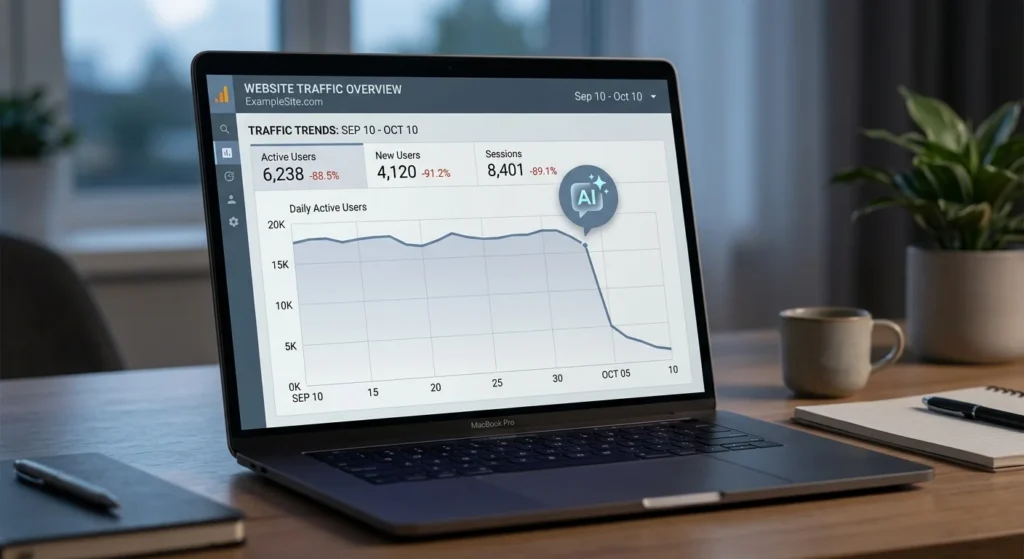
For most sites, the honest answer is: traffic drops, and for a lot of them, revenue follows right behind it. But that’s not the whole story, because the hit isn’t landing evenly, and a handful of sites are actually doing fine, or better than fine, in the exact same environment that’s quietly wrecking everyone else.
Here’s what’s actually happening, who it’s happening to, and why a few sites are finding a way around it.
How Much of the Click Is Actually Gone
Start with the raw numbers, because they’re stark enough to explain why this is treated as an existential issue rather than a minor SEO adjustment. Multiple 2026 industry analyses put the overall zero-click rate — searches that end without a visit to any website at all — somewhere between 58 and 68 percent in the US. When an AI Overview specifically appears on the results page, that number climbs further, with several trackers putting it above 80 percent.
Ahrefs’ own February 2026 data found that AI Overviews cut click-through rates for the top-ranking organic result by 58 percent compared to the same query without an overview showing — nearly double the drop it had measured just eight months earlier. Put plainly, the position that used to reliably earn a click is earning dramatically fewer of them, and the trend is accelerating, not leveling off.
Real Sites, Real Losses
The stats only tell half the story. The other half is a growing list of specific, named sites where this has already translated into layoffs, shutdowns, and lost income.
Gisele Navarro runs HouseFresh, an air purifier review site that was already hit hard by an earlier Google algorithm change before AI Overviews made things worse. She told Bloomberg that her content increasingly shows up inside Google’s AI summaries now — but the clicks that used to come with ranking well simply aren’t following it there anymore, as reported by PPC Land’s coverage of the broader traffic decline.
Morgan McBride’s experience is even starker, partly because of the irony involved. McBride runs Charleston Crafted, a DIY home improvement site that Google itself featured in a 2024 advertising campaign. About a month after that campaign aired, her traffic from Google had fallen more than 70 percent, and her display ad revenue dropped 65 percent in the year that followed — losses large enough that she and her husband eventually laid off staff.
Business Insider cut 21 percent of its staff in 2025, with CEO Barbara Peng pointing specifically to steep traffic declines the company said were outside its control. Separate tracking found Business Insider’s search traffic had fallen by more than half over roughly three years, a drop that closely tracked the broader rollout of AI-generated search answers, according to reporting on the pattern across major publishers.
Some of the numbers from individual sites are genuinely jarring. An analysis tracking ten major tech publications found Digital Trends had gone from roughly 8.5 million monthly clicks down to around 265,000 — a 97 percent collapse. CNN’s traffic dropped somewhere between 27 and 38 percent year over year depending on how it was measured, and Helen Havlak, publisher at The Verge, told NPR the site’s own decline lined up closely with the rise of AI Overviews.
None of these are small, struggling blogs with nothing else going for them. These are established, well-resourced publishers, which is part of why the pattern has been taken so seriously across the industry.
It’s Not Hitting Every Type of Site the Same Way
If you run a business that sells something directly, there’s a genuine piece of good news buried in all this: transactional searches — queries with obvious buying intent, like “best X for Y” or anything with “buy” or “price” attached — trigger AI Overviews far less often than purely informational ones. Some estimates put AI Overview coverage on commercial queries as low as 10 percent, largely because Google still needs to send someone to an actual store to complete a purchase.
Informational content is where the damage concentrates. Review sites, how-to guides, health and symptom information, and DIY content are exactly the categories where AI Overviews now trigger most consistently — in healthcare, education, and B2B topics, some industry tracking puts AI Overview appearance above 80 percent of queries. Monetization platform Raptive has separately estimated that if AI Overview coverage keeps expanding as projected, traffic to food blogs specifically could eventually fall by half.
If your site’s whole business model runs on someone reading a list, a recipe, or a set of symptoms and then leaving — that’s precisely the kind of query Google’s AI is now built to answer without you.
The Twist: Some Sites Are Doing Fine, or Better
Here’s the part that complicates the doom narrative. Not every brand is getting flattened, and a few are gaining ground specifically because of how they show up inside the AI layer rather than beneath it.
Being cited as a source inside an AI Overview appears to carry real value on its own — one analysis found that brands cited in AI Overviews earned 35 percent more organic clicks than brands that weren’t, even accounting for the overall drop in clicks across the board. There’s also a quality argument worth taking seriously: Similarweb’s research found that visitors arriving from ChatGPT converted at roughly 7 percent on transactional sites, compared to about 5 percent from Google, and spent close to twice as long on the page once they got there. Fewer total visitors, in other words, doesn’t automatically mean less valuable traffic — sometimes it means the opposite, with casual browsers filtered out and more motivated ones making it through.
There’s also an attribution problem hiding inside all of this. Zero-click brand exposure — someone seeing your name inside an AI answer without clicking anything — appears to be quietly driving people to search for your brand directly later on, which standard analytics tools tend to misfile as “direct traffic” with no connection back to the original AI Overview that planted the idea. That means some of what looks like a pure loss in the data is actually traffic that just became harder to trace, not traffic that disappeared outright.
What Google Says About All This
Google has consistently pushed back on the idea that AI Overviews are damaging the open web. The company’s position is that it still sends meaningful traffic to websites, that visitors who do click through after seeing an AI Overview tend to spend more time on the resulting page, and that a lot of what gets counted as “zero-click” is actually a successful outcome for the user rather than a failure for the publisher — someone getting their answer is not automatically the same as someone being cheated out of a visit they were owed.
We’ve gone into more detail elsewhere on how AI Overview citations actually get chosen, including the publisher lawsuits and the EU antitrust complaint challenging exactly this dynamic. That legal fight is still working its way through courts and regulators, which means the underlying tension here isn’t close to settled.
What Sites Are Actually Doing About It
The response across the industry has mostly converged on a few overlapping strategies, rather than any single fix:
Treating AI visibility as its own metric, separate from raw clicks. A citation inside an AI Overview carries brand exposure and authority even without a visit attached, and more site owners are now tracking how often they’re cited rather than judging success by clicks alone — tracking we’ve written about in more depth when covering what actually gets a page cited in the first place.
Building audience relationships that don’t route through Google at all. Email lists, app notifications, and social followings don’t disappear when a search algorithm changes, which is why they’re increasingly described as the real hedge against this shift rather than any particular SEO trick.
Pursuing direct compensation from AI platforms. A handful of publishers have negotiated licensing arrangements with AI companies for the use of their content, though multiple outlets, including Raptive, have said the payments involved don’t come close to replacing the ad and affiliate revenue being lost.
Leaning harder into commercial and transactional content, where AI Overview coverage remains comparatively light, rather than competing head-on in the informational categories where the feature now dominates.
So What Actually Happens?
For a lot of websites — particularly review sites, DIY blogs, and informational publishers who built their whole business around someone clicking through to read the full answer — the practical result of AI Overviews has been less traffic, less ad revenue, and in several documented cases, real layoffs or outright shutdowns. For businesses selling something directly, or for sites that manage to get cited consistently and build audience channels Google doesn’t control, the picture is messier and, in some cases, genuinely fine.
The one thing that doesn’t seem to be in dispute, even from Google’s own side of the argument, is that the old deal — publish good content, get rewarded with a click — isn’t the deal anymore. What replaces it is still being worked out, case by case, lawsuit by lawsuit, and site by site.
Frequently Asked Questions
How much has website traffic actually declined because of Google AI Overviews?
It varies widely by site and content type, but documented cases range from roughly 30 to 97 percent declines in Google-driven traffic, with several major publishers citing AI Overviews as a direct factor in staff layoffs.
Do all types of websites lose traffic equally to AI Overviews?
No. Informational content — reviews, how-to guides, health and DIY information — is hit hardest, since AI Overviews trigger on these queries most often. Commercial and transactional searches, where someone needs to visit an actual store to buy something, are affected far less.
Can a website actually benefit from being cited in an AI Overview?
Yes, to some extent. Research has found that brands cited inside AI Overviews earn more organic clicks than uncited competitors, and traffic arriving from AI tools has shown higher conversion rates and longer time on site in some analyses, even though overall click volume is lower.
What is Google’s response to claims that AI Overviews are hurting publishers?
Google maintains that it still sends significant traffic to websites, that AI Overview click-throughs tend to be higher-quality visits, and that much of what’s labeled “zero-click” represents a successful search outcome for the user rather than lost value for the publisher.
What are websites doing to adapt to declining search traffic?
Common strategies include building direct audience channels like email and apps that don’t depend on Google, optimizing content specifically to earn AI Overview citations, pursuing licensing agreements with AI companies, and shifting focus toward commercial queries where AI Overview coverage remains lower.
Is this traffic decline permanent?
It’s treated as an ongoing, accelerating trend rather than a temporary dip. Google continues expanding AI Overview and AI Mode coverage, and most industry forecasts expect click-through rates for informational content to keep declining rather than recover.
