


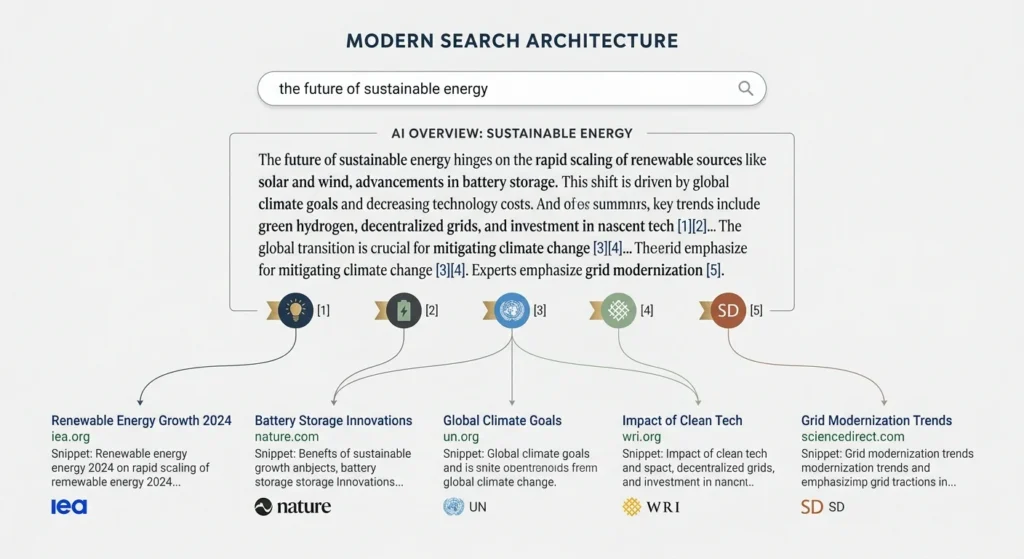
Google AI Overview is the AI-generated summary that now appears above the traditional blue links on a growing share of Google searches, answering the question directly on the results page instead of making you click through to find out. It’s reshaping search in a way that matters to anyone who runs a website, because the entire game has shifted from “rank on page one” to “get named inside the answer itself” — and those aren’t automatically the same thing.
Here’s how the system actually works, how citations get chosen, and what the growing publisher backlash against it says about the tradeoffs involved.
What Is Google AI Overview, and How Common Is It Now?
Google officially rolled out AI Overviews in the US in May 2024, and by early 2026 they’ve become a permanent, central part of how Google Search works rather than an experiment. A large-scale Conductor study covering 21.9 million searches found AI Overviews appeared on 25.11 percent of searches in the first quarter of 2026, and their prevalence has climbed steadily — Semrush separately tracked a jump from 7.64 percent to 13.14 percent of searches over just one month in early 2025, according to Contently’s data-backed breakdown of the trend. Awareness has followed the same trajectory: Gartner reports that 82 percent of consumers say they’ve noticed AI Overviews appearing in their search results.
Google has also expanded a related, more conversational feature called AI Mode, which turns search into an ongoing back-and-forth exchange rather than a single generated summary. According to Google’s own figures, AI Mode passed 1 billion monthly users during 2026, with query volume more than doubling every quarter since launch, and the company made Gemini 3.5 Flash the default model powering it worldwide, as reported by Nexuro Digital’s guide to the feature. The distinction between the two is straightforward: AI Overviews appear automatically inside a normal search, while AI Mode is a separate space users deliberately open when they want to dig into a topic more conversationally. Both run on the same underlying idea — an AI-written answer with cited sources, sitting above or replacing the traditional list of links.
How Google AI Overview Actually Works
AI Overviews aren’t a chatbot answering from general knowledge — they’re built directly on top of Google’s existing search infrastructure. The system runs on the Gemini large language model combined with Google’s Organic Search Index, and it moves through several distinct stages to construct each answer, based on a detailed breakdown of the mechanism published by SearchAtlas:
- Query fan-out. Google breaks a single search into a set of related sub-questions, rather than treating it as one isolated query. A search about, say, a product comparison might silently trigger sub-searches covering pricing, reviews, and alternatives, each retrieving its own set of results.
- Retrieval. For each of those sub-questions, the system pulls candidate pages from Google’s Organic Search Index — the same underlying index that powers ordinary search results.
- Semantic extraction. Rather than reading and citing an entire page, the system identifies specific passages — chunks of text — that most directly answer each sub-question.
- Generative synthesis. Gemini combines the extracted passages into a single, coherent written answer, prioritizing what Google calls entity clarity, contextual alignment, and factual consistency across the sources it pulled from.
- Retroactive linking. Citations are attached back to the specific sources the synthesized answer actually drew from, which is why an AI Overview can cite several different websites within one paragraph.
The practical upshot is that Google isn’t picking one “winning” page the way traditional search ranks a list — it’s assembling an answer from fragments across multiple pages, and your site’s job is to be one of the sources that fragment gets pulled from.
How Websites Actually Get Cited
Ranking well in ordinary search results remains the floor, not the whole game. Research on citation patterns found that more than 76 percent of AI Overview citations come from pages already ranking on page one of organic results, and a separate analysis found that 99.5 percent of cited sources ranked within the top 10 organic results for that query, according to SearchAtlas’s data. In other words, you generally can’t get cited in an AI Overview without already ranking well the old-fashioned way — but ranking well doesn’t guarantee a citation either. Structure and extractability decide who actually gets pulled from that qualifying pool, per AirOps’ citation research.
Position on the page matters more than most site owners expect. The same research found that 55 percent of citations pull specifically from the top 30 percent of a page’s content — meaning the passage most likely to get lifted into an AI Overview is one near the top of the article, not buried several sections down. That’s a strong argument for front-loading a direct, complete answer near the start of a piece, rather than building up to it gradually the way traditional narrative-style articles often do.
The format of the passage itself matters just as much as its position. Content structured as short, self-contained answer units — a clear question as a heading, followed immediately by a complete, standalone answer in the first sentence — is the format most likely to get extracted cleanly, according to an analysis of 100 cited pages conducted by CXL. A real-world example of this pattern in action: one writer found their LinkedIn article cited as the opening definition in an AI Overview, and traced the win directly to a short, plain-language definitional sentence that Google could lift word-for-word, plus a question-formatted heading that matched one of the fan-out sub-queries almost exactly, as documented by EditorialGe’s case study.
A few other structural factors consistently show up in citation research: clean heading hierarchy that mirrors how people actually phrase questions, claims backed by specific statistics or named sources rather than vague assertions, and schema markup, which one 2026 guide describes as having shifted from a nice-to-have into essential infrastructure for AI visibility, according to Averi’s optimization playbook. Importantly, there’s no special AI-specific tag or switch to flip — Google has confirmed no unique markup is required, and citation comes down entirely to the underlying quality and structure of the content itself.
Getting Cited Isn’t the Same as Getting Traffic
This is the part that catches a lot of site owners off guard: a citation inside an AI Overview doesn’t reliably translate into a visit to your site. Pew Research found that when an AI summary appeared above the results, users clicked through to a traditional organic result in only 8 percent of visits, compared with 15 percent when no AI summary was shown — and clicked on a link inside the AI summary itself in just 1 percent of visits, based on the same Pew data cited across multiple industry analyses of the shift.
That gap is the central tension of this entire feature. Being cited establishes visibility and, arguably, some brand authority in front of the person searching — but it doesn’t behave like a traditional organic ranking, where a top spot reliably drove a click. For many queries, the AI Overview is now genuinely the last thing a searcher sees, whether or not they ever open your page.
The Bigger Controversy: Publishers Are Pushing Back
That traffic gap isn’t just a theoretical concern for site owners — it’s now the subject of active litigation. Penske Media Corporation, which owns Rolling Stone, Variety, Billboard, and more than a dozen other outlets, filed a federal lawsuit against Google in September 2026, arguing that AI Overviews repurpose publishers’ journalism to generate summaries that keep users on Google’s own results page instead of visiting the original source. The complaint cites a decline of more than a third in Penske’s affiliate revenue since late 2024, and says AI Overviews now appear on roughly 20 percent of searches that link to its sites, according to reporting on the filing from Outlook Business. Penske’s central argument is that opting out isn’t a real option — leaving Google’s index entirely would be far more damaging than staying in and accepting the traffic loss.
Penske isn’t alone. Online education company Chegg filed a separate lawsuit earlier in 2026 making a similar argument about AI Overviews eroding demand for its original content. And in June 2025, advocacy groups the Movement for an Open Web and Foxglove filed a formal antitrust complaint against Google with the European Commission and the UK’s Competition and Markets Authority, citing independent research — including an Ahrefs analysis of 300,000 keywords — that found AI Overviews reduced organic clicks to top-ranking websites by 34.5 percent year over year, per PPC Land’s coverage of the complaint.
Google has consistently rejected these claims as without merit, arguing that AI Overviews make search more useful overall and, as a result, drive more total search activity — which the company says sends traffic to a wider and more diverse set of sites than before, not a narrower one. In response to the mounting pressure, Google has also rolled out several changes aimed specifically at publishers, including a “Further Exploration” links section, clearer subscription labeling, and more inline link context within AI-generated answers, according to reporting on the company’s response to the Penske suit.
Both sides have real data behind their positions, and the dispute is still working through courts and regulators rather than being resolved — which means the underlying tension between AI-generated answers and the sites that supply their source material isn’t going away soon.
Practical Takeaways for Website Owners
- Ranking well organically is still the prerequisite, not an alternative. The overwhelming majority of AI Overview citations come from pages that already rank in the top 10 organically — there’s no shortcut that bypasses solid SEO fundamentals.
- Put your clearest, most complete answer near the top of the page. More than half of citations pull from the first third of a page’s content, so burying your best material deep in the article works against you here specifically.
- Structure content as standalone answer units. A clear question as a heading, followed immediately by a complete, self-contained answer, is the format most consistently pulled into AI-generated summaries.
- Back claims with specific, checkable details. Named sources, concrete statistics, and direct quotations all measurably increase how often content gets surfaced in AI-generated answers, according to the research cited above.
- Track citations separately from rankings. A citation means your page was actually pulled from and linked; a brand mention elsewhere is a different, softer signal. Google Search Console has begun surfacing generative-search visibility data specifically for this purpose.
- Set realistic traffic expectations. Given how rarely users click through when an AI Overview is present, getting cited is worth pursuing for visibility and authority — but it shouldn’t be treated as a guaranteed replacement for the clicks a strong organic ranking used to reliably deliver.
Frequently Asked Questions
What is Google AI Overview?
It’s an AI-generated summary, powered by Google’s Gemini model, that appears above traditional search results and answers a query directly using information pulled from multiple web pages, with citations linking back to the original sources.
How does Google AI Overview decide which sources to cite?
It uses a process called query fan-out to break a search into related sub-questions, retrieves candidate pages from Google’s organic index for each one, extracts the specific passages that best answer each sub-question, and then generates a combined answer with citations linked back to those passages.
How can my website get cited in Google AI Overview?
Rank well organically first, since the vast majority of citations come from pages already in the top 10 results. Beyond that, structure your content with clear, self-contained answers near the top of the page, use descriptive question-based headings, back claims with specific statistics or named sources, and implement schema markup.
Is there a special tag or setting to get featured in AI Overviews?
No. Google has confirmed there’s no dedicated markup or switch that guarantees inclusion — citation depends entirely on the underlying quality, clarity, and structure of the content itself.
Does getting cited in an AI Overview actually bring traffic to my site?
Not reliably. Research from Pew found users click through to a cited link in only about 1 percent of visits where an AI Overview appeared, and click a traditional organic result in just 8 percent of those visits, compared with 15 percent when no AI Overview was shown.
Why are publishers suing Google over AI Overviews?
Publishers including Penske Media (Rolling Stone, Variety, Billboard) and Chegg argue that AI Overviews repurpose their content to answer search queries directly, cutting the referral traffic and ad or affiliate revenue that previously came from users clicking through to their sites. Google disputes this, saying AI Overviews increase overall search usefulness and traffic diversity.
