


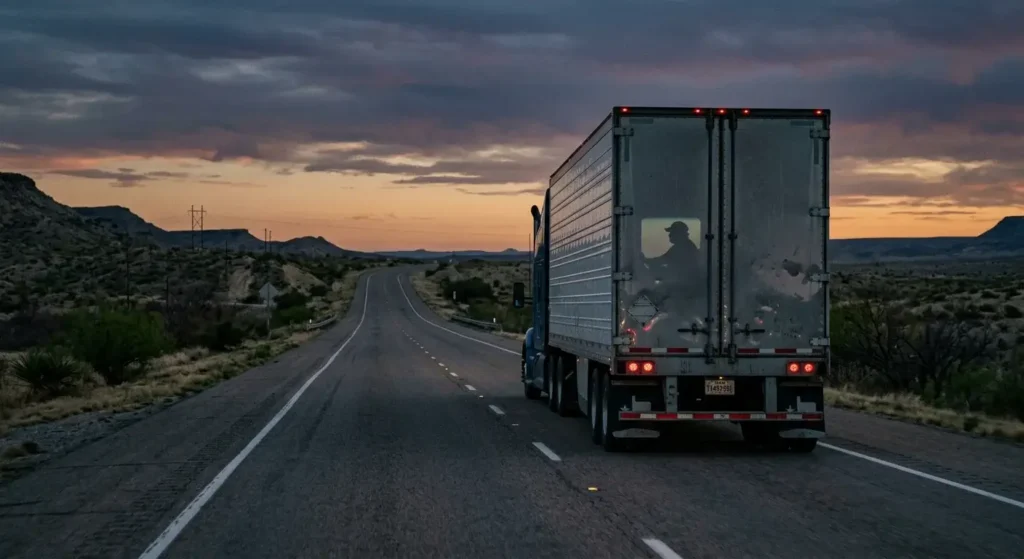
Driverless trucks are real. They’re hauling paid freight in Texas right now, and on October 7 the federal government cleared one of the main regulatory obstacles in their way. They are also still very rare. Aurora, the company furthest along on public highways, had about 25 trucks in service in early August. The US has more than 2.2 million heavy and tractor-trailer drivers.
So will AI replace truck drivers? It will take over a real share of long-haul highway driving at some point, and the first job losses will probably show up there. Replacing the profession is a far bigger claim, and nothing on the road today supports it on a short timeline. Here is what’s actually running, what the forecasts say, and which parts of those forecasts are educated guessing.
What’s driving itself right now
Aurora began commercial driverless runs in Texas in spring 2025. By the end of June 2026 it had logged nearly 440,000 driverless miles, and the company says none of its collisions were caused by its software, according to FreightWaves’ coverage of its second-quarter results. Those are Aurora’s own figures, so read them as the company’s account rather than an audit.
Its routes now stretch across Texas and into the Southwest. The longest, Fort Worth to Phoenix, covers roughly 1,000 miles and takes about 15 hours, per SupplyChain 24/7. Aurora says it has customers lined up for 200 driverless trucks by the end of 2026, according to its Q2 release. FreightWaves put the actual fleet at roughly 25 trucks across all hardware generations as of August 1.
The business is still tiny. Aurora reported $2 million in second-quarter revenue against a $270 million net loss, and guided to $14 to $16 million in revenue for the full year.
Not every run has been fully empty, either. At a partner’s request, Aurora kept a human observer in the cab on one Texas route, Axios reported in December. The company’s newer fleet runs without anyone behind the wheel.
Kodiak is the other name to know. It reported 35 driverless trucks hauling frac sand for Atlas Energy in the Permian Basin as of June 30, according to Runtime Wire. Atlas wants 100 by mid-2027, and FreightWaves reports the fleet is expected to move onto public roads in early 2027. Kodiak’s first planned long-haul lane is Dallas to Houston, with IKEA named as a launch partner, though that service had not launched at the time of the report.
Put those together and you get a few dozen trucks per company. That’s the whole picture of driverless freight in the country, as far as the public numbers show.
How many truck drivers are there?
The Bureau of Labor Statistics counted 2,221,200 heavy and tractor-trailer truck drivers in 2025, with median pay of $58,640. It projects 4 percent growth through 2035, or about 83,800 more jobs. Add light delivery trucks and driver/sales workers and one January analysis from AI Exposure arrives at roughly 3.5 million driving jobs in total.
Even if Aurora reaches 200 trucks by December, that is about one driverless truck for every 11,000 heavy-truck drivers. A driverless truck does more work than a single driver can, since it doesn’t have to stop for mandated rest, and Aurora sells that around-the-clock capacity as a feature. That changes the math by some multiple, not by orders of magnitude.
Why long-haul highways go first
The pattern AI Exposure describes is a transfer-hub model. Automated trucks run the long highway stretch between hubs, and people handle everything on either end. The reasons are practical. Urban driving with pedestrians and cyclists is harder for software, and so are snow, ice and heavy rain, construction zones, an officer waving traffic through, and backing a trailer into a dock. Last-mile delivery sits at the hard end of the scale.
The early lanes are mostly Sun Belt routes, which keeps the worst weather out of the test. Aurora says its next-generation hardware has better sensor cleaning aimed at harsher conditions, as Dallas Innovates reported, but that remains a company goal and not a track record.
What the forecasts say
The AI Exposure analysis lays out a timeline in three stages:
- 2026 to 2030: a net loss of 30,000 to 80,000 driving jobs.
- 2030 to 2035: 200,000 to 400,000 long-haul positions eliminated.
- 2035 to 2045: 1 to 2 million driving positions gone, and up to 2.5 million in its most aggressive scenario.
The same analysis expects driverless trucks to cover 15 to 25 percent of long-haul interstate miles by 2032 and 40 to 60 percent by 2040, with local and urban delivery staying mostly human through at least 2035.
Treat that as scenario modeling by one data site, not a measurement. The ranges are wide because nobody knows how fast carriers will adopt this. On the industry side, Aurora CEO Chris Urmson told Axios the US will have “thousands” of driverless trucks within five years. Even 5,000 trucks would be about a fifth of one percent of the heavy-truck workforce.
Urmson also said, per FreightWaves, that carriers adopt the technology for “capacity and asset utilization” rather than to cut headcount. That is a company executive’s framing, but it shows how Aurora is selling. It’s targeting $0.85 or more per mile for its driver-as-a-service subscription and $2 or more per mile when it runs the whole truck for a carrier.
What’s slowing it down
Money. Scaling costs far more than the revenue coming in. Aurora says its second-generation hardware kit should cost half as much as the previous one, and that its manufacturing partner Roush reaches a run-rate of 1,000 trucks a year in October. Those are plans, not deliveries.
Federal rules. On October 7, the FMCSA granted a five-year exemption, running through October 7, 2031, that lets driverless trucks use cab-mounted amber beacons in place of reflective warning triangles, FreightWaves reported. A truck with nobody aboard can’t put triangles on the road, so this was a real obstacle. It replaces a series of three-month waivers Aurora had been running under since October 2025. The beacons must activate within five minutes of a stop, and hazardous materials and passenger hauling are excluded.
The exemption wasn’t uncontested. The Owner-Operator Independent Drivers Association, the Truck Safety Coalition and Advocates for Highway and Auto Safety were among the opponents, and the application drew 402 comments. Critics raised concerns about trailers blocking the lights, single electrical failures, and whether the testing covered enough weather and lighting conditions.
Organized opposition. The Teamsters want a human operator holding a commercial license in every autonomous truck and call driver replacement a threat to road safety and good trucking jobs, according to the same Axios report. Urmson’s counter is that trucking is dangerous work with health and quality-of-life problems, and that drivers could move into terminal operations or dispatch. That’s his argument, and nobody has shown yet that those jobs will exist in the numbers needed.
So will AI replace truck drivers?
Parts of the job, yes, and the long highway legs in good weather go first. The whole occupation, not on any timeline the current deployments back up. Right now it’s a few dozen driverless trucks against 2.2 million drivers, with regulation, cost and hard driving conditions all still in the way.
Trucking isn’t the only physical job facing this kind of pressure. We covered which jobs humanoid robots could realistically take over in a separate piece.
If you want to track whether the forecasts above are holding, a few things are worth watching:
- Whether Aurora actually reaches 200 trucks by year-end.
- Whether human observers disappear from the remaining routes.
- Kodiak’s move onto public roads in early 2027.
- Whether the IKEA service launches.
- How the beacon exemption holds up under pressure from its opponents.
Frequently Asked Questions
Will AI replace truck drivers?
Some of them, over time. Driverless trucks are already running paid freight in Texas, and forecasts expect them to take a growing share of long-haul highway miles. Local and urban delivery, and the loading and last-mile work around the highway leg, are expected to stay mostly human for years.
How many driverless trucks are on the road in the US?
There is no official national count that I could find. Aurora had about 25 trucks across its hardware generations in early August and aims for 200 by year-end. Kodiak reported 35 driverless trucks for Atlas Energy as of June 30, hauling sand in the Permian Basin.
Are driverless trucks allowed on public roads?
Aurora is running commercial driverless freight on Texas highways today. On October 7, the FMCSA gave carriers a five-year exemption allowing amber beacons in place of warning triangles, which removed a federal obstacle for trucks with no one aboard.
Which truck driving jobs are safest from automation?
Per the AI Exposure analysis, local and urban delivery. It expects these to stay mostly human through at least 2035, because of dense traffic, loading docks and last-mile complexity.
How soon could driverless trucks take over long-haul freight?
One analysis projects 15 to 25 percent of long-haul interstate miles by 2032 and 40 to 60 percent by 2040. Aurora’s CEO expects thousands of driverless trucks within five years. These are forecasts, and the actual pace will depend on regulation, cost and safety results.
Is there anyone inside a driverless truck?
It varies. Aurora’s newer fleet runs with nobody behind the wheel, but it kept a human observer on one Texas route at a partner’s request, per Axios.
