


It’s 9 p.m. and it’s still 88 degrees outside. You skipped your evening walk because the heat made you nauseous, you’ve had two popsicles and a glass of rosé since dinner, and the ceiling fan is the only thing standing between you and a bad night’s sleep. Tomorrow you’ll tell yourself you’re “eating clean,” right up until a coworker brings watermelon margaritas to the office happy hour.
Summer weight loss has a specific set of problems that January diets don’t. It’s not about willpower dropping off a cliff — it’s that the entire environment changes. Meals move outdoors. Alcohol shows up more often. Exercise routines that worked in March become miserable in July. And appetite itself shifts when the temperature climbs, which throws off habits that used to run on autopilot.
None of that means summer is a bad time to lose weight. In some ways it’s easier — produce is cheaper and better, heavy comfort food loses its appeal, and there’s more daylight for movement. The trick is working with the season instead of fighting it.
What Actually Moves the Needle in Summer
Weight loss still comes down to a calorie deficit — eating less energy than your body uses. Heat doesn’t change that math, but it changes how you get there. Hot weather naturally suppresses appetite for a lot of people, which can work in your favor if you don’t undo it with sugary drinks. At the same time, heat makes structured exercise harder to sustain, so relying on workouts alone to create a deficit is riskier in July than in November.
The most reliable summer approach leans more on food choices and daily movement (walking, swimming, yard work) and less on grinding out intense workouts in the heat. That’s not a downgrade — it’s just matching the strategy to the season.
Sweating a Lot? That’s Not Fat Loss
It’s tempting to treat a soaked t-shirt as proof of progress. It isn’t. Sweat is your body’s cooling system, not a fat-burning indicator — it’s mostly water and electrolytes leaving your body to help regulate your core temperature. A sauna suit, a hot afternoon, or a session of hot yoga can make the scale drop two pounds by dinnertime, but that number comes back as soon as you rehydrate, because it was never fat to begin with.
Real fat loss happens over days and weeks through a sustained calorie deficit, not through how drenched your shirt gets during one workout. If anything, chasing sweat as a metric can backfire — it pushes people toward overdressing or overexerting in heat, which raises the risk of heat exhaustion for no actual fat-loss benefit.
How Much Water You Actually Need Right Now
General hydration guidelines suggest roughly 15.5 cups (about 3.7 liters) of total fluids a day for men and 11.5 cups (about 2.7 liters) for women, counting food and drinks combined — but that’s a baseline for a temperate climate, not a heat wave. Once temperatures climb, or you’re sweating from activity, your needs go up from there.
A few things that push your water needs higher in summer:
- Any activity that makes you sweat. Extra fluid before, during, and after is standard advice, and during heavy exercise in hot conditions, aiming for roughly two to four cups of fluid per hour is a reasonable target.
- Humidity. High humidity slows sweat evaporation, so your body works harder to cool down, which increases fluid loss even if you don’t feel like you’re sweating more.
- Alcohol and caffeine. Both have a mild diuretic effect, which compounds fluid loss on a hot day.
- Illness, fever, or a stomach bug. These raise fluid needs regardless of the season, but they hit harder when it’s already hot.
A simple check: if your urine is pale yellow and you’re rarely thirsty, you’re probably drinking enough. Dark yellow urine, a headache, or feeling unusually tired in the heat are signs to drink more before your next glass of water, not after.
Summer Foods That Make a Deficit Easier
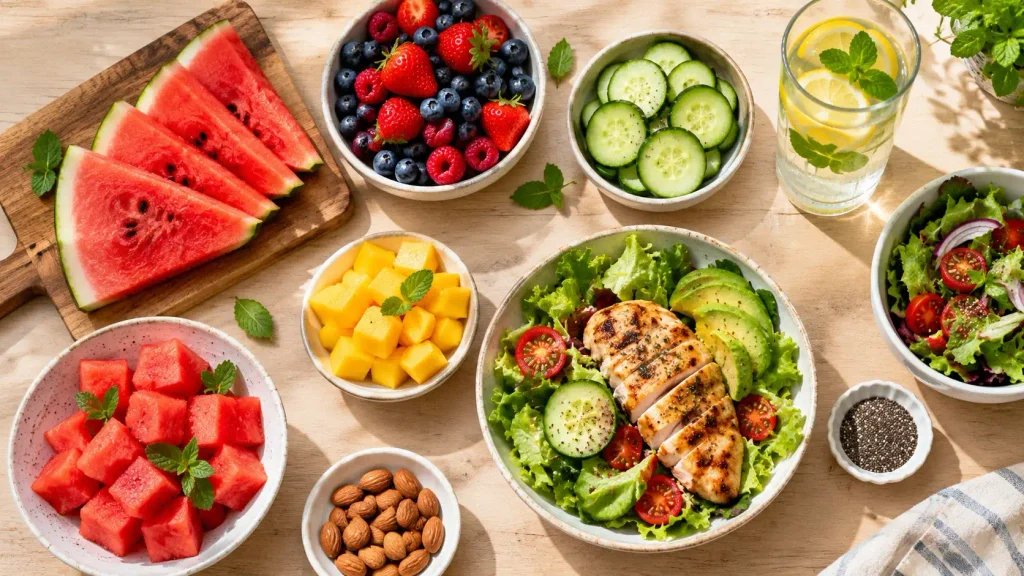
The goal isn’t to eat “clean” in some abstract sense — it’s to eat foods that fill you up without a lot of calories, because summer produce happens to be great at that. Water-rich fruits and vegetables add volume and hydration for relatively few calories, which matters more in the heat, when large, heavy meals feel unappealing anyway.
| Food | Approx. Calories | Why it works in summer |
|---|---|---|
| Watermelon (1 cup, diced) | ~46 | High water content, naturally sweet, easy on a hot stomach |
| Cucumber (1 cup, sliced) | ~16 | Almost pure water and fiber, good salad or snack base |
| Grilled chicken breast (4 oz) | ~185 | High protein, works cold in salads the next day |
| Greek yogurt (1 cup, plain) | ~150 | Protein-dense, pairs well with fruit for breakfast |
| Corn on the cob (1 ear, no butter) | ~90 | Fiber-rich grilled side that doesn’t need heavy sauces |
| Shrimp (4 oz, grilled) | ~120 | Light, high-protein, cooks fast without heating up the kitchen |
| Berries (1 cup, mixed) | ~65 | Low-calorie sweetness for dessert cravings |
None of these require you to avoid carbs or fat — they’re simply calorie-efficient enough that you can eat a satisfying volume of food without quietly going over your target.
Drinks and the Hidden Calories That Undo a Good Day
This is where most summer weight-loss efforts actually stall. A single frozen drink at a rooftop bar can carry more calories than a full meal, and it’s easy to lose track because the calories come in liquid form, which doesn’t register the same way solid food does.
| Drink | Approx. Calories | Notes |
|---|---|---|
| Frozen margarita (12 oz) | 400–550 | Sugar syrup plus alcohol adds up fast |
| Sweetened iced tea (16 oz) | 140–180 | Unsweetened version is close to zero |
| Fruit smoothie, restaurant-made (16 oz) | 300–450 | Often has added sugar on top of the fruit |
| Regular soda (12 oz) | ~140 | Diet or sparkling water is the near-zero swap |
| Beer, regular (12 oz) | ~150 | Light beer often runs 90–110 |
| Sparkling water with citrus | 0–5 | Good default for “something to sip on” |
| Iced coffee, black | 5–15 | Watch what gets added — syrup and cream change this fast |
You don’t have to cut alcohol or sweet drinks entirely. Picking one or two per week to actually enjoy, rather than defaulting to a sugary drink every time you’re thirsty, keeps the calories from stacking up without turning summer into a diet of plain water and regret.
Exercising Safely When It’s Hot Outside
Exercising in heat puts real strain on the body, and the CDC has specific guidance for it because heat-related illness during exercise is common enough to take seriously. The core recommendations are straightforward:
- Time it right. Early morning or evening, avoiding the window roughly between 10 a.m. and 3 p.m. when heat and sun exposure peak.
- Start slow and build up. Ease into the workout rather than going hard from the first minute, especially if you’re not used to exercising in heat yet.
- Drink before you’re thirsty. Waiting for thirst means you’re already behind on fluids. Muscle cramping can be an early warning sign of heat-related trouble.
- Dress for it. Loose, lightweight, light-colored clothing helps your body cool itself instead of trapping heat.
- Know the warning signs. Dizziness, nausea, headache, or feeling unusually weak means stop the activity and get somewhere cool — those are early signs of heat exhaustion, and pushing through is how heat stroke happens.
If Outdoor Workouts Are Miserable, Do This Instead
Not every hot climate has a comfortable early-morning window, and not everyone has the schedule flexibility to exercise at 6 a.m. If outdoor workouts just aren’t realistic right now, a few practical alternatives hold up just as well for weight loss:
- Indoor strength training. Even a basic bodyweight or dumbbell routine at home avoids the heat entirely and still builds the muscle that keeps your metabolism steady.
- Swimming. It’s low-impact, keeps your body cool while you move, and burns a meaningful amount of energy.
- Air-conditioned walking. Malls, big-box stores, and indoor tracks exist for exactly this reason — a brisk 30-minute walk indoors counts.
- Shorter, more frequent sessions. Three 10-minute walks scattered through the day can be more sustainable in heat than one 30-minute session that leaves you drained.
The point isn’t to “earn” your workout by suffering through the heat. Consistency matters more than heroics.
Managing Hunger After a Hot Workout
Exercise in heat tends to blunt appetite in the short term, and then rebound with a stronger hunger signal a few hours later — often around the time people are least prepared for it (mid-afternoon, or right before bed). A couple of things help here:
- Have a plan for the post-workout window instead of grazing. A protein-forward snack (yogurt, a hard-boiled egg, cottage cheese with fruit) tends to be more satisfying than reaching for whatever’s easiest.
- Rehydrate before you eat. Thirst is frequently mistaken for hunger, especially after sweating, so a glass of water first can clarify whether you’re actually hungry.
- Don’t skip meals to “make room” for a workout snack later — that usually backfires into overeating once the hunger catches up with you.
BBQs, Restaurants, and Summer Gatherings
Summer social calendars are built around food — cookouts, patio dinners, pool parties, vacations. Treating every one of these as a diet violation is a fast way to quit altogether, so the more useful approach is picking your battles.
- Eat something before you arrive. Showing up hungry at a BBQ where the first thing you see is chips and queso rarely ends well. A small protein snack beforehand takes the edge off.
- Build your plate around protein first. Grilled meat, fish, or chicken at a cookout is usually the lowest-regret choice — load half the plate there before reaching for sides.
- Pick one indulgence, not five. If the potato salad and the s’mores and the second beer all sound good, choose the one you actually want most instead of a little of everything.
- Watch the drink count more than the food. At most gatherings, alcohol and sugary punch add up faster than the food does.
Sleep, Late-Night Eating, and Summer Heat
Longer daylight hours and hot bedrooms both interfere with sleep, and poor sleep has a well-documented relationship with weight management — it affects hunger hormones and makes late-night snacking more likely, since a tired body tends to crave quick energy from sugar and refined carbs. A few adjustments that matter more in summer than other seasons:
- Keep the bedroom as cool and dark as possible, even if that means a fan, blackout curtains, or shifting your sleep schedule slightly.
- Watch the late-evening ice cream or chips habit that shows up when it’s too hot to sleep and the freezer is right there. If you’re going to have a treat, having it earlier in the evening rather than at midnight tends to sit better with both sleep and appetite the next day.
- Limit alcohol close to bedtime — it disrupts sleep quality even though it can feel relaxing in the moment, especially on a hot night.
A Realistic Summer Day of Eating
This isn’t a meal plan to follow exactly — it’s an example of what a normal, sustainable day can look like without extreme restriction:
- Breakfast: Greek yogurt with berries and a drizzle of honey
- Mid-morning: Iced coffee, black or with a splash of milk
- Lunch: Grilled chicken salad with cucumber, tomato, and a light vinaigrette
- Afternoon: Sliced watermelon or an apple with a handful of almonds
- Dinner: Grilled shrimp or fish, corn on the cob, a side salad
- Evening: A small bowl of mixed berries, or a square or two of dark chocolate if something sweet is wanted
This adds up to a moderate calorie deficit for most adults without cutting out entire food groups or requiring you to track every gram.
Common Mistakes That Slow Down Summer Progress
- Drinking calories without noticing. Frozen cocktails, sweetened iced coffee, and juice add up fast and don’t register the way food does.
- Skipping meals because it’s “too hot to eat.” This usually leads to overeating later, often on less-controlled foods at night.
- Treating every hangout as an exception. If every weekend includes multiple “cheat” meals, the weekday effort gets canceled out.
- Over-restricting on hot days, then overcorrecting. Extreme calorie cuts to compensate for a big weekend tend to backfire into binge-eating later.
- Confusing water weight with fat loss. A lighter scale reading after a sweaty day is dehydration, not progress — don’t let it justify skipping food or water the next day.
- Ignoring hydration until symptoms show up. Waiting until you’re thirsty or lightheaded means you’re already behind.
A Simple Plan to Start This Week
- Pick one sugary drink you have regularly and swap it for a lower-calorie version (sparkling water, unsweetened iced tea, black coffee) for the next seven days.
- Move your workout — even a short walk — to early morning or evening, and have water with you before you feel thirsty.
- Build one meal a day around a lean protein and a water-rich vegetable or fruit rather than starting from carbs or sauce.
- Before your next cookout or gathering, eat a small protein-based snack beforehand so you’re not arriving hungry.
- Set a bedtime routine that keeps your room cooler and skips the late-night freezer trip when possible.
Small, repeatable changes like these tend to hold up better through a hot summer than a strict plan that only works when the weather cooperates.
FAQs
Does sweating a lot mean I’m burning more calories?
Not necessarily. Sweat is your body’s cooling mechanism, and how much you sweat depends on genetics, fitness level, body size, and the temperature and humidity around you — not directly on how many calories you’re burning. A soaked shirt after a walk in 95-degree heat doesn’t mean you burned more than the same walk on a cool day; it just means your body worked harder to stay cool. Fat loss depends on your overall calorie balance over days and weeks, not on how much you sweat in a single session.
Is it normal to lose my appetite in the heat?
Yes, a reduced appetite in hot weather is common — your body redirects some energy toward cooling itself rather than digestion, and heavy meals can feel unappealing. This can work in your favor for weight loss as long as you don’t compensate with liquid calories (sugary drinks, alcohol, ice cream) once your appetite for solid food returns in the evening.
How much water should I drink if I’m trying to lose weight in summer?
General guidance puts daily fluid needs around 11.5 cups for women and 15.5 cups for men, including food, but hot weather and exercise push that higher. A practical approach is to drink consistently through the day rather than waiting until you’re thirsty, and to increase intake on days you sweat more, whether from heat or activity. Pale yellow urine is a reasonable sign you’re keeping up with your needs.
Can I still lose weight if I can’t exercise outside because of the heat?
Yes. Weight loss depends primarily on your overall calorie balance, and food choices tend to have a bigger impact than exercise alone. Indoor strength training, swimming, or air-conditioned walking cover the exercise side just as well, and adjusting your eating habits — especially drinks and portion sizes at social events — often matters more during a hot summer than pushing through uncomfortable outdoor workouts.
Why does the scale go down after a hot, sweaty day and then come back up?
That drop is water weight, not fat. Heavy sweating temporarily reduces your body’s fluid levels, which shows up on the scale, but it returns once you rehydrate. It’s a normal fluctuation and not a sign that you’ve lost or regained actual body fat overnight.
How many pounds per week is realistic to aim for in summer?
The same range applies year-round: about 1 to 2 pounds per week is generally considered a sustainable, safe pace, achieved through a moderate calorie deficit of roughly 500 to 1,000 calories per day. Summer doesn’t speed this up — heat and sweating don’t create extra fat loss — but the season can make it easier to stick with a deficit if you lean on lighter, water-rich foods and stay active with lower-intensity movement.
Are frozen drinks and cocktails really that bad for weight loss?
They’re not “bad” in a moral sense, but they’re calorie-dense in a way that’s easy to underestimate — a single frozen margarita or piña colada can run 400–600 calories, close to a full meal. Having one occasionally and enjoying it is very different from having one every time you’re out, which is often where summer weight-loss plans quietly stall.
What should I eat before a BBQ so I don’t overeat?
A small protein-containing snack 30–60 minutes beforehand — a hard-boiled egg, a handful of nuts, or a bit of yogurt — takes the edge off hunger so you’re not making decisions on an empty stomach the moment you arrive. It’s a small step that makes it easier to build your plate around protein and vegetables instead of starting with chips and dip.
